MStrings
mStrings extracts strings from files and classifies them using regular expressions, YARA rules, and MITRE ATT&CK mappings. It highlights potential indicators of compromise and suspicious behavior, grouping matches by tactic and technique. Ideal for quickly surfacing malicious capabilities in binaries, scripts, and documents.
Also accepts macOS Mach-O binaries and .app bundles — when given a bundle, the main executable is auto-resolved via Info.plist's CFBundleExecutable, falling back to the sole binary in Contents/MacOS/ if that lookup fails.
Note: The MITRE Technique Lookup bar, introduced in v3.0.1 has been removed. It has been replaced with a full MITRE lookup utility (no internet required.)
IOC Extraction
Alongside the Sigma-style detection matches, mStrings pulls out well-formed Potential Filesystem IOCs and Potential Network IOCs into their own report sections — paths, URLs, domains, and IPs found either as standalone strings or embedded in a longer one (a command line, a query string). Reserved/documentation IP ranges (loopback, broadcast, RFC 5737 test ranges, and similar) are excluded automatically, since they show up constantly in any binary's networking stack but are never real indicators.
Network IOCs are shown defanged (http:// → hxxp://, every . → [.]) everywhere mStrings displays them — CLI output, saved reports, and the Analyze rollup that embeds them. This is deliberate: a raw URL rendered as clickable-looking text is the wrong thing to put in front of an analyst repeatedly. If you need the real string back — to build a YARA rule, for example — Strings to YARA automatically refangs any defanged line before it becomes a rule.
Multi-Layer Obfuscation
mStrings recursively decodes base64 content it finds — including base64 nested inside base64, up to 12 layers deep — and re-runs detection against whatever it unwraps to. When a detection only fires after peeling more than one layer, that's flagged directly on the finding (⚠ found after N layers of base64 decoding in the summary table, Base64×N in the detail table's encoding column) — a single decode is routine, but deliberate re-encoding multiple times over is itself an evasion signal worth noting.
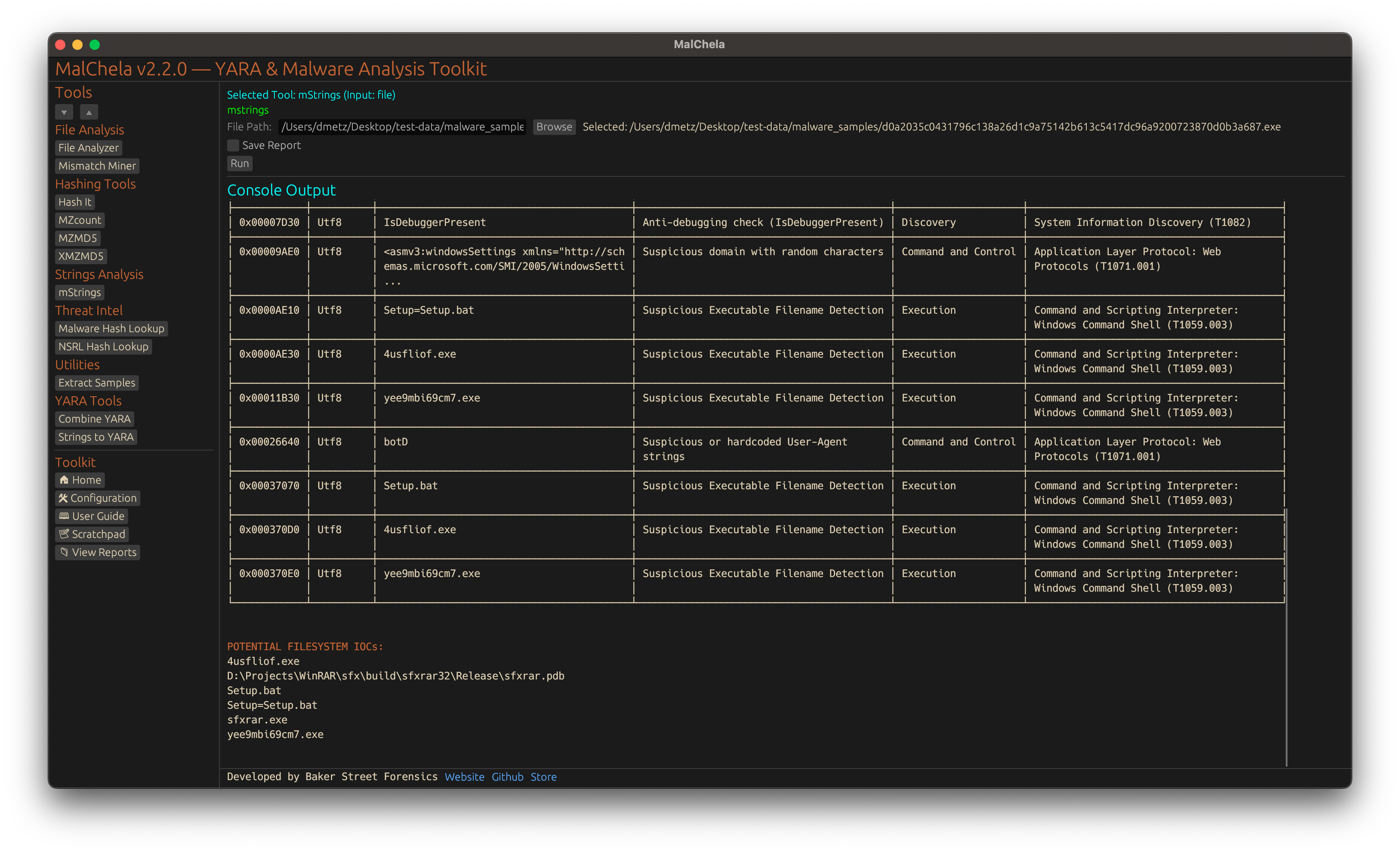
MStrings
🔧 CLI Syntax
# Example 1: Scan a file
cargo run -p mstrings -- /path_to_file/

# Example 2: Save output as .txt
cargo run -p mstrings -- /path_to_file/ -o -t

# Example 3: Save output to a case folder
cargo run -p mstrings -- /path_to_file/ -o -t --case CaseXYZ

# Example 4: Scan a .app bundle (main executable resolved automatically)
cargo run -p mstrings -- /path/to/Sample.app
Use -o to save output and include one of the following format flags:
- -t → Save as .txt
- -j → Save as .json
- -m → Save as .md
If no file is provided, the tool will prompt you to enter the path interactively.
When --case is used, output is saved to:
saved_output/cases/CaseXYZ/mstrings/
Otherwise, results are saved to:
saved_output/mstrings/
The MITRE Lookup feature is only available in the web interface version of mStrings.